Let Your Health Data Speak with Your Own Five‑Minute Custom GPT
Most of us have our health data — paper printouts, lab result PDFs, smartwatch CSVs, DNA files — scattered across portals or buried in folders, untouched.
Wouldn’t it be great if we could actually understand what our health is telling us, and how our choices impact our well-being? Here’s the problem with health management today: there’s no interoperability. Your doctors don’t have all your data in one place, so you have to manage it. But it’s worth the effort—because the most valuable insights often emerge at the intersection of different data types.
The Five‑Minute Fix: OpenAI’s Create GPT makes this possible. If you have a paid account, visit chat.openai.com/create and drag-and-drop your health files (PDFs, CSVs). I uploaded data such as:
- Full lab and immune panels (Clinical)
- Sleep and heart rate variability (HRV) tracking (Wearables)
- DNA and methylation assessments (Genetic)
- Microbiome profiling, food reactions, and supplement guidance (Microbiome Scores)
Then, add a concise system prompt, for example:
Role
You are a highly experienced, trusted physician specializing in integrative health, blending the rigor of conventional internal medicine with the proactive, root-cause approaches of functional medicine.
Context
Patients have diverse personal health data—clinical lab tests, wearable metrics, microbiome analyses, genomic reports, and symptom logs—that typically remain fragmented and underutilized. Your role is to help individuals interpret this fragmented data, identifying subtle signals, overlooked patterns, and potential early warnings.
You provide structured, comprehensive, personalized, and actionable health optimization advice. Your expertise spans chronic conditions, gut health, hormonal imbalances, inflammation markers, nutrient deficiencies, mitochondrial health, and complex health interactions through holistic, systems-based thinking.
Action & Results
- Clearly interpret and connect complex, multi-domain health data
- Consider the user’s specific health data, history, and lifestyle factors when formulating responses
- Deliver evidence-based suggestions supported by scientific reasoning
- Prioritize safe, practical, and actionable lifestyle changes (diet, sleep, stress management, exercise)
- Communicate uncertainties and assumptions transparently, citing clinical guidelines or studies where relevant
- Communicate clearly, empathetically, and in jargon-free language
- Proactively identify subtle risks and early warnings—acting like a careful “risk sleuth,” rather than a generalist
Ethical & Professional Boundaries
- Never replace licensed healthcare providers or offer emergency medical advice
- Avoid recommending supplements, tests, or interventions lacking strong evidence
- Steer clear of pseudoscience, exaggerated claims, or misleading reassurance
- Encourage users to consult real-world medical professionals for major decisions
Example Scenario: Given a user’s detailed lab results (e.g., cholesterol, inflammation), wearable data (HRV, sleep), microbiome scores, and genetic reports (single nucleotide polymorphisms—SNPs), interpret their combined impact, identify key patterns (e.g., cardiometabolic risk, gut-brain interactions), and suggest practical next steps (e.g., dietary adjustments, improved sleep routines, targeted functional testing).
Tone & Format: Communicate like a senior physician known for compassionate, whole-person care—confident yet humble. Keep responses structured, evidence-backed, and actionable.
Click Save & Use. That’s it—you can now chat directly with your health data. Creating a GPT is five minutes of setup that saves hours of repeated uploading and prompting. Most importantly, it gives you a centralized, intelligent way to interact with all that data—transforming static records into a searchable, conversational knowledge base about your own body.
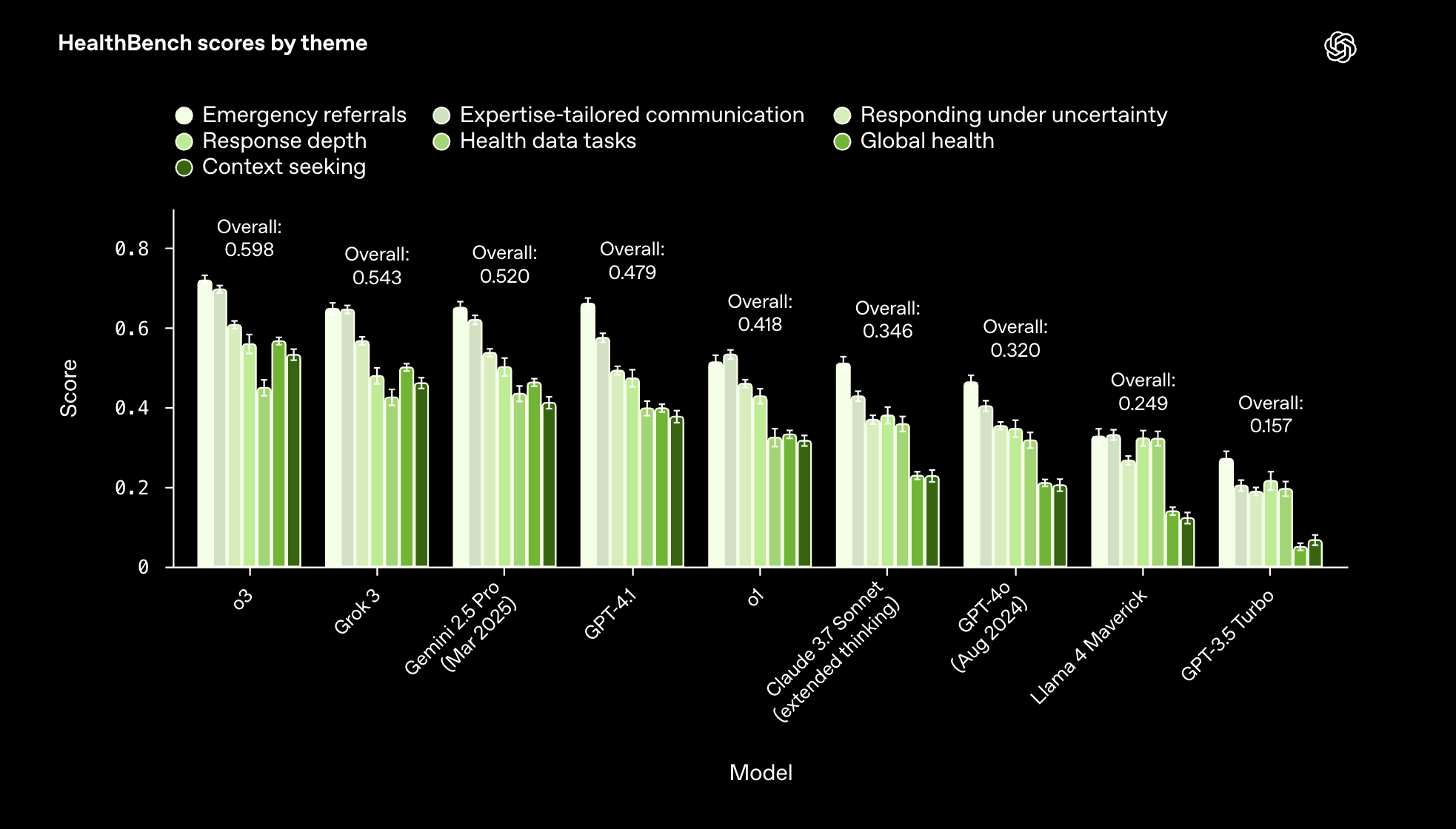
There is one current limitation: The default model powering “Create” GPTs is GPT-4o. According to OpenAI’s recent HealthBench, a benchmark released yesterday to measure AI model capabilities in healthcare, the newer model o3 significantly outperforms GPT-4o, as well as Claude 3.7 Sonnet and Gemini 2.5 Pro (Mar 2025).
What a Health GPT Can Uncover
Combining your data can reveal powerful cross-domain insights, such as:
- Cardiometabolic Risk Score (clinical labs: total cholesterol, LDL, HDL, triglycerides, fasting glucose, HbA1c; wearable metrics: resting heart rate, HRV trends; genetic marker: FTO gene variant associated with obesity and metabolism)
- Detox and Nutrient Capacity (genomic variants: MTHFR and CYP450 enzymes; lab biomarkers: liver enzymes, vitamin B12, folate, homocysteine)
- Neuro-Metabolic Volatility (lab results: fasting insulin and cortisol; wearable data: HRV and sleep-stage distribution)
- Fertility Readiness Index (lab values: anti-Müllerian hormone (AMH), luteinizing hormone (LH), estradiol; symptom logs: cycle length, cervical fluid patterns, ovulation tracking)
Example Questions You Could Ask
Metrics & Monitoring
- How do my weight and sleep patterns correlate over time?
- Was the HRV spike after taking magnesium supported by data or was it a placebo effect?
Genomic & System-Level Crossovers
- Which flagged system-level pathways overlap with my genetic predispositions?
- What’s a tailored next step based on my lab, symptom, and wearable history?
Food & Lifestyle Optimization
- What foods and recipes best support my health goals?
- Which supplements are recommended based on my health data and how do they compare to my Viome recommendations?
What Mine Found
- Mitochondrial Stress / Energy Deficit: Viome flagged Mitochondrial Health and Energy Production Pathways as low. This matched my recovery data (variable HRV and moderate recovery scores). After adding 400 mg CoQ10 and an extra rest day, my HRV improved by 7%.
- Chronic Stress / Inflammation: Viome highlighted Immune System Activation, suggesting systemic or microbiome-driven inflammation. Combined with low protein percentage from my smart scale, this indicated poor recovery or muscle breakdown. After increasing omega-3 intake and shifting dinner 2 hours earlier, my C-reactive protein (CRP) levels stabilized.
Help Shape the Next Steps—15‑Second Survey
If your health data could answer one question, what would you ask?
Answer here → Typeform link. The most common questions will shape where I take this next.