The Health Tool I Wish My Family Had Had
Introducing Helse — now in beta.
A couple of winters ago, a week before Christmas, my husband’s brother-in-law died of a heart attack at 36. It wasn’t a bolt from the blue — for months he knew something was wrong, and the system kept telling him it was stress. I wrote about it here. The autopsy found a 90% blockage and a pancreatic tumor nobody had gone looking for. Every warning sign had been there, assessed one at a time, and waved through.
That’s the thing about how we do health: it waits for a crisis. Your data lives in a dozen portals, your labs come back “normal” (which doesn’t mean what you think it means), and nobody — no doctor, no app — is holding the whole thread and watching it move.
So I built the tool I wish my family had had. It’s called Helse, and today it’s in beta. It’s the opposite of anxiety: the calm of actually knowing, of catching the slow drift before it becomes an event.
It’s for whatever you’re keeping an eye on: fertility and IVF, perimenopause, your heart and metabolism, your thyroid, a parent’s care, even your dog. Try it at gethelse.com, free while it’s in beta, or look around a sample profile first, no sign-up needed.
What it does
Helse is one place for all of your health — every result, diagnosis, symptom and bill — read in context, watched over time, and ready to take to your next doctor.
On the sample profile (every number is made up): tap Off target, and two results your lab would call normal come up. Open one, and Helse says why, with its source. Try it yourself, no sign-up needed.
Take the whole picture to your next doctor
A new doctor starts from zero: fifteen minutes, and whatever you remember to mention. With Helse, you bring the whole thread. It makes a one-page summary for them, in the order of the International Patient Summary — the international standard for what a doctor needs when they don’t know you: your allergies and reactions first, then your medications, diagnoses and findings, visits and procedures, vaccines, tests and imaging, your latest lab results, your symptoms from the last three months, your care team and your insurance. Untick anything you’d rather leave out, then print it or save it as a PDF.
It’s written for the doctor, so it shows your results against your lab’s own ranges only — never Helse’s targets, and no AI reading. The decisions stay theirs; they just get to make them with everything in front of them. (For your dog, the same page is written for the vet.)
For everyone you look after
Health is rarely only yours to watch. Helse keeps a profile for everyone you look after: a parent, a partner — and yes, your dog. That last part is where the idea came from: I was trying to keep track of my dogs’ vet visits, scattered across clinics, and realized it was the same problem one step sideways. A pet’s profile keeps the vet visits and vaccines on one timeline, a symptom diary and a diet diary, what he’s taking and when, and his bloodwork and weight over the years, read against the vet lab’s own range.
Share any profile with a partner or a family member (or the dog sitter), to view it or to help keep it up to date. When a parent’s results arrive from three different clinics, that’s the difference between everyone guessing and everyone looking at the same page.
How it works
You hand Helse anything with health data in it — a lab PDF, a photo of a paper report, a body scan, screenshots from your clinic’s portal, a message from your doctor — and it works out what it is, files every result on the day it was drawn, and shows you what it found before anything is saved. From there, the app is laid out the way you’d think about your own health: what’s true about you, what your data says, and what to do about it.
About you: what Helse knows
- Your profile. Your age, your sex and your life stage — trying to conceive, pregnant, perimenopausal, postmenopausal — with the date it started, because the same number means different things at different points in life.
- Your focus: what Helse pays attention to. Something you’re working toward or going through — better egg quality, a healthier heart, an IVF cycle, a stubborn injury. Each one decides which markers Helse puts first, how it reads your results and what goes into your supplement protocol — but never moves a target: a healthy range doesn’t change because you want it to. And each gets its own page for the tests, appointments, medications and notes that go with it, so when something is worth watching, it doesn’t become a number you’ve forgotten by the time you’re back in the parking lot.
- One timeline for everything. Every visit, test, result, diagnosis and symptom, newest first, with where it happened and who you saw.
- What it all costs. Every bill, estimate and receipt you hand Helse (a physical, a lab estimate, a vet invoice) is linked to the visit or test it paid for, with who billed it and what insurance paid or refused. It’s totalled by year and by provider, with estimates kept apart from the final bill so nothing is counted twice. Your insurance ID numbers never leave the original document.
Your results: what your data says
- Every marker, tracked over time, with a plain-language summary of what’s improving and what’s slipping. For the common markers, Helse knows how much each one naturally wobbles from one test to the next, so noise doesn’t get reported as news.
- Each number read in context. Your sex, your age when the blood was drawn, your life stage, where you were in an IVF cycle, whether you’d fasted. When a comparison wouldn’t be fair — a glucose from a draw that may not have been fasted, an estradiol taken mid-stimulation — Helse says it won’t judge that number, and why, instead of guessing.
- The evidence, and how strong it is. Next to your lab’s “normal,” Helse shows a target wherever the research supports one, with its source one click away — and says so plainly where it doesn’t. Findings that aren’t targets, like a trial where a supplement didn’t help, appear as research notes, labelled for what they are. And when your own doctor gives you a number, it outranks everything.
- Patterns, not just numbers. When several heart-and-metabolic markers drift the wrong way together — each one still “normal” on its own — Helse flags it. That’s exactly the kind of pattern that got waved through in my family.
- Your wearable. Connect a WHOOP, and your recovery, heart-rate variability, resting heart rate and sleep sit right alongside your labs — this week against your own usual, because a wearable’s numbers only mean something against your own baseline.
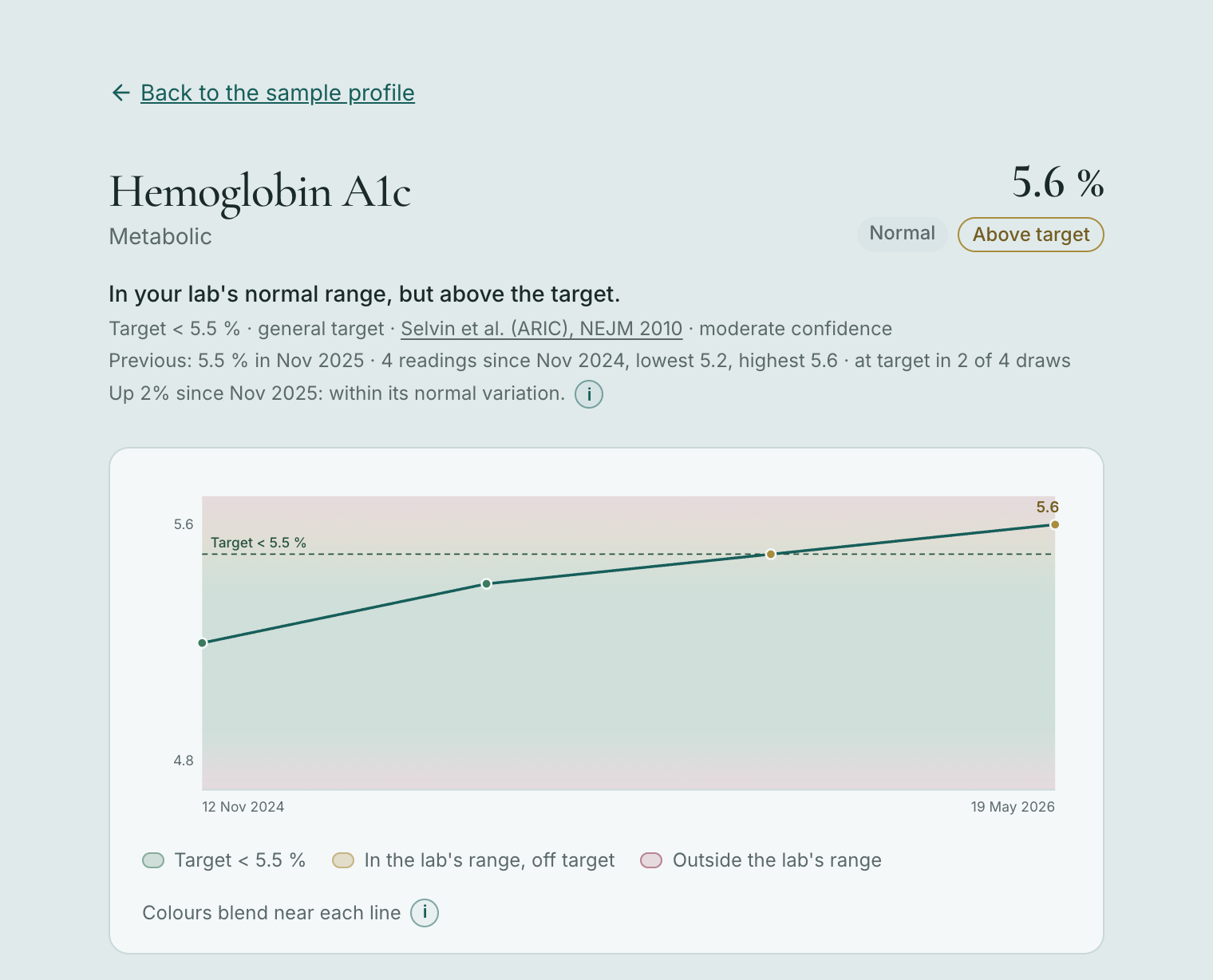
A marker page on the sample profile (the numbers are made up): normal by the lab’s range, above the target the research supports, with the source one click away.
Add your own results at gethelse.com, or open this page on the sample profile, no sign-up needed.
Your plan: what to do about it
- What your results mean. What changed since your last results, and what it means for your focus: your priorities, why each one matters for what you’re working toward, and a concrete next step for each. It works from the same targets and sources as the rest of the app, and isn’t allowed to add a target of its own.
- When your next screening is due. Your Pap, mammogram or colonoscopy, found on your own timeline and timed by the official schedule for your age — and after an abnormal result, a note that your doctor sets the date instead.
- A supplement protocol built for you. Dosed, and scheduled across your day — morning, midday, evening, bedtime, with food or without — with the interactions between supplements flagged, and anything your doctor prescribed treated as fixed. Want something changed? Just say it in plain words — “I’m vegetarian”, “fewer pills, please”, “nothing with iodine” — and it redraws the protocol on the spot, showing exactly what would change before you apply it. If a request could mean two things, it asks.
Every target has a source
Most health apps hand you “optimal” ranges with nothing behind them. Before Helse showed a single target, every one was checked against the research, at the source.
Of the 60 markers people most often give “optimal” ranges for, only 10 had a target that held up — and those are the ones Helse uses. Several popular numbers didn’t hold up at all: there’s no agreed target for fasting insulin, and the general goal for ApoB is under 100 — the lower numbers you’ll see quoted are for people at high risk, or have nothing behind them. Seven more have real evidence that isn’t a target — a link to lower mortality in one study, a guideline since withdrawn, a number the medical societies disagree on. For the other 43, Helse tells you the honest answer: nothing beyond the lab’s normal range.
Where that kind of evidence bears on you, Helse shows it. Women with higher vitamin D have had better IVF results in observational studies — but when a randomized trial gave women with low vitamin D a large dose before IVF, pregnancy rates didn’t go up. If fertility is what you’re focused on, that finding sits right under your number on your vitamin D page, labelled for exactly what it is.
Up close: it takes the shape of your concern
Helse isn’t a fertility app. But fertility was something I was optimizing for while I built it, and watching Helse bend around it is what convinced me the idea works.
Fertility treatments come with a wealth of detail that decisions are made on: monitoring scans with a row of follicle sizes, retrieval counts, embryology reports — paperwork no health app is built for. Hand Helse a screenshot of one, and it works out what kind of record it is, designs a form to hold it and reads the first one in. Every one after that is a screenshot away, and its numbers chart over time like any lab result. Tell it which forms are scans and which are retrievals, and the records group themselves into IVF cycles, so one round sits next to another — follicles, eggs, embryos — side by side. The clinic bills land in Costs, next to the visit each one paid for.
None of that was written for IVF alone. Hand Helse the reports that come with your own concern, and it builds the same kind of place for them. Name what you’re focused on, and it picks out the lab results that bear on it, including the ones you haven’t had tested yet.
What it isn’t
None of this is about becoming a hypochondriac or replacing your doctor. It’s health managed the way an actuary manages risk — trends, not snapshots; probabilities, not panic. It won’t hand you confident numbers with nothing behind them, and it won’t pretend “normal” means “fine.” What it gives you is a better conversation with your doctor, with the whole picture in hand.
Helse is in beta at gethelse.com, and free while it is. Start with the lab reports you already have — PDFs, photos, portal screenshots — and see your results line up by date on one chart.
Since I’m asking you to hand over lab results, here’s what’s true today:
- Your data isn’t sold, and isn’t used for advertising.
- Your documents are read by Anthropic’s Claude, under terms that don’t let it train on them.
- Helse’s own analytics never see your health data — not your results, not even which test you opened.
- Before launch, Helse went through an exhaustive security review — sharing, uploads, accounts, the AI — and every issue it found was fixed.
- Delete your account, and everything in it goes with it.
The privacy policy says all of this in plain language rather than legalese.
If your own health data has ever felt like it was working against you, come kick the tires — and tell me what’s missing, at hello@gethelse.com.
Stop reacting to your health. Start staying ahead of it.
— Olga
Not ready to add your labs yet?
One email when there's real news about Helse. Nothing else.